Traditional Art and AI-Generated Art: Two Ways to See One Experience
How I Combined Traditional Art and AI-Generated Art: One Experience, Two Creative Paths
I have spent much of my life making art and thinking about how people express things that are not always easy to put into words. Sometimes we understand what we feel before we know how to explain it. Without knowing a reason, just colors can occur. Sometimes, they could be lines, shapes, movements of the hand. An image may appear before we have a complete story for it.
Now that I am learning more about artificial intelligence, I have started wondering what happens when that very human way of creating meets AI-generated art. Can traditional art and AI-generated art express the same feeling in different ways? I decided to try a simple experiment using one of my own paintings. I would begin with an artwork representing my feelings and thoughts, describe what it means to me, and then ask AI to create another image from that same story. I was not trying to find out which one could make the better picture, but I wanted to know what I might discover by looking at both.
My Painting Came First
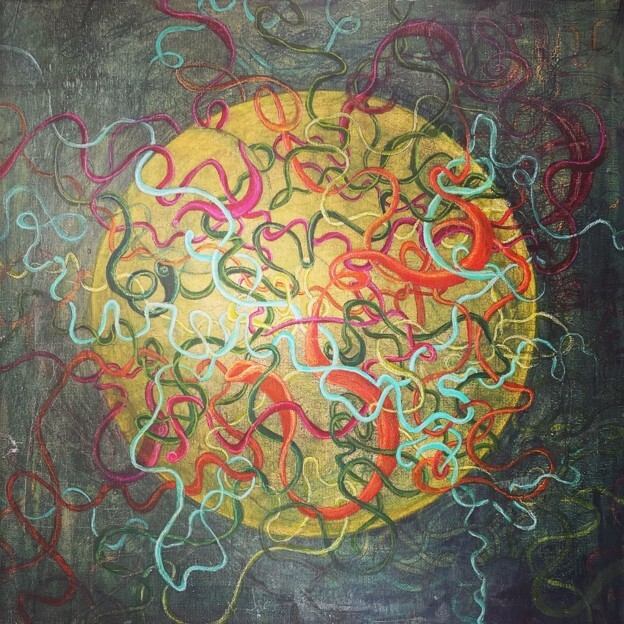
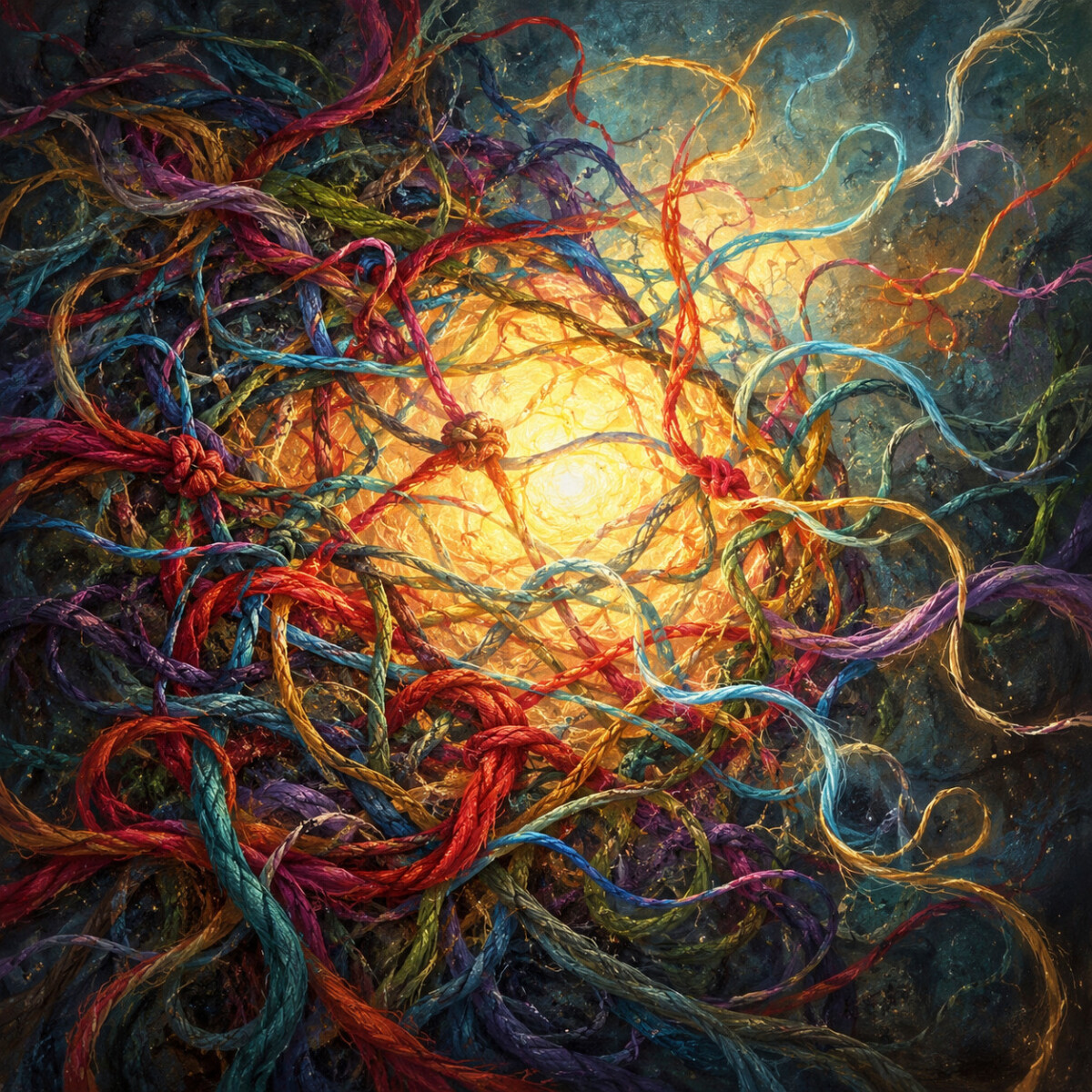
I started painting what I think healing feels like. At the center is a large area of warm, golden light. Around it are threads in many colors. They twist, cross, loop, overlap, and become tangled together. Some seem to move toward the center, while others appear to cover it.
When I look at the painting, I think about my past. The threads remind me of a ball of yarn that has become badly tangled. One thread crosses another, disappears underneath something else, and becomes connected to another knot. That is often how difficult experiences from the past feel to me. They do not always exist as separate memories that can be understood one by one. They can become connected, layered, complicated, and sometimes even conflicting.
One experience can lead to another feeling. One memory can bring up another question. Eventually, it can become difficult to know where one thread begins and another ends.
But There Is Light Inside the Tangle
The most important part of this painting for me is not simply the tangled threads. It is the process of untangling them. I imagine healing as slowly finding one thread at a time and beginning to loosen the knots that have formed around the light in the middle of the art. The tangled threads can make it harder to reach, see, or feel that light.
Sometimes the process of untangling can bring confusion, tension, or discomfort. But gradually, one thread can be identified. One knot can be loosened. Then another. For me, that process can become a way of understanding what became tangled along the way, recognizing what still belongs to me, and beginning to let go of what no longer needs to stay tightly knotted. The goal is to slowly make enough space for the light that was already there to shine through the darkness.
Then I Wondered What AI Would See
I did not begin this painting with a written description or a clear plan for what it was supposed to mean, but the image came first. The lines, colors, movement, and relationships between the shapes emerged through the process of making it. Only later did I begin putting its meaning into words and thinking more carefully about what I wanted to explore.
AI-generated art works differently. AI cannot begin with the feeling inside me. I first have to translate that feeling into language. Then AI interprets those words and creates an image from them.
The process becomes: Feeling → Words → AI → Image
My traditional artwork followed a different path: Feeling → Hands → Image
That difference made me curious. What would AI notice after I had already translated my experience into words? What might it emphasize, simplify, change, or completely miss?
The Story I Would Give AI
To create the second image, I would explain my painting and its meaning in words. My prompt could sound something like this:
Create an expressive image about carrying difficult and suffocating experiences from the past. Imagine those experiences as many colorful threads tangled tightly around a bright light at the center. The threads represent memories, pain, questions, and experiences that have become connected, layered, and difficult to separate. The light represents something bright that has always existed within me.
The image should suggest that moving forward is not about destroying the threads. It is about slowly loosening the knots and untangling the threads one at a time, so I can gradually come closer to the light that has always been there. Include both darkness and light. Do not make the image feel completely resolved or perfectly peaceful. It should still feel like an ongoing process.
The same story would now exist in two different visual forms. One began with my hands. The other began with my words.
Looking at the Two Images Side by Side
My original painting feels closer to the inside of the experience. Part of that may be because not only I spent time physically making it but also I was moving through the process while I painted, making choices, responding to the colors, and noticing what was happening as the image developed.
The tangled lines were not added because I had intellectually decided that tangled lines would be a good symbol for my past. They emerged through the act of making the painting. The movement feels unsettled. The lines overlap, cross, disappear, and return. The image does not feel completely organized because, at times, my own experience has felt completely chaotic. That is part of what makes the painting feel true to me.
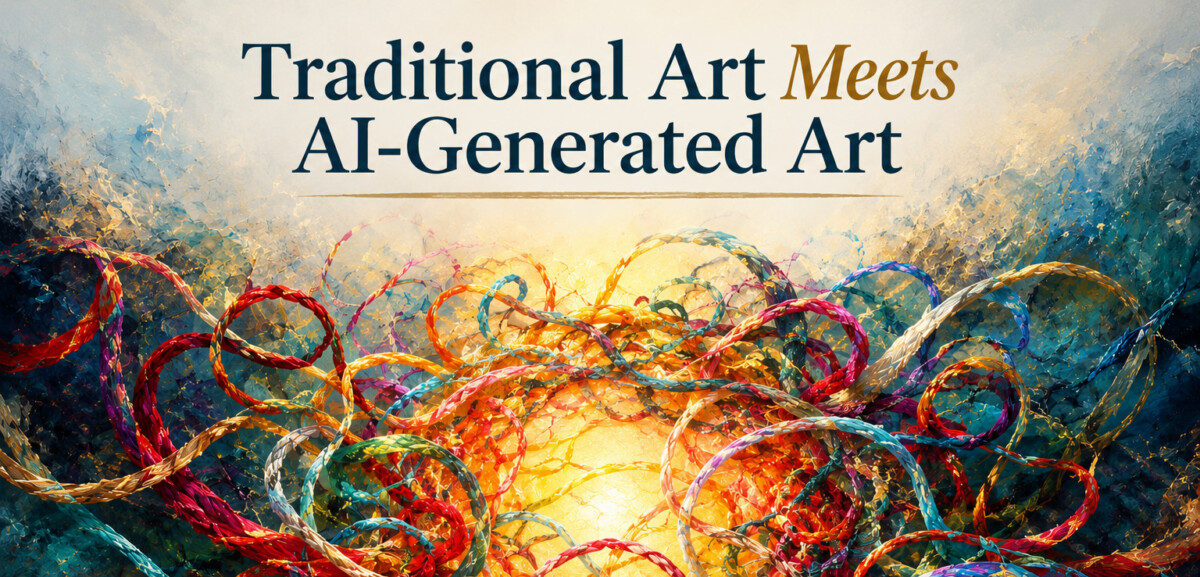
The AI-generated image feels different. It reflects the story after I had already translated the experience into words. In some ways, it feels like seeing my own story returned to me from the outside. That distance created a different kind of reflection. The AI image did not feel like a replacement for my original painting. Instead, it felt almost like another layer of self-portrait, one created after I had already begun to understand and describe what the original image meant to me.
Looking at both images together allowed me to see the same experience from two directions. One came from inside the process. The other came back to me after I had put the experience into language.
AI Can Show Me Something, But It Cannot Know What I Feel
AI can generate an image from my description but cannot know what those tangled threads actually feel like inside me. It does not remember my past or feel the pressure or confusion represented by those lines. The meaning still comes from me. AI gives me another image to respond to. That is very different from AI telling me what my image means.
My Reaction to the AI Image May Matter More Than the Image
Vivid! That was my first impression. The AI-generated image felt almost as if I were looking at something through a microscope. The tangled threads appeared larger, more detailed, and almost alive. I could see knots, layers, textures, and connections that felt much more magnified than in my original painting. That made me think about perspective. Sometimes we look at an experience from far away and see one larger picture. Other times, we look closely and begin to notice the smaller pieces inside it.
The AI image felt like another lens through which I could look at the same story. It did not necessarily express my experience more accurately than my original painting. Instead, it showed me a different visual interpretation of something I had already expressed. That difference gave me something new to respond to.
It made me wonder whether AI-generated art can sometimes offer another perspective, not because AI understands what we feel, but because it rearranges our words and ideas into something we did not create ourselves. Seeing that unfamiliar version of my own story helped me notice things I had not considered before. And perhaps that is where the value of this experiment is for me. The AI image does not have to be right. It simply has to give me another way to look.
AI Art Does Not Have to Replace Making Art With Your Hands
As I learn more about AI-generated images, I do not find myself becoming less interested in traditional art. Actually, the opposite may be happening. Working with AI makes me notice more clearly what is different about making something with my own hands.
With physical art materials, I make hundreds of small decisions while I work. I choose the pressure of a line, the direction of a brushstroke, the amount of color, what to cover, what to leave visible, and when to stop. There is a physical relationship between the person, the material, and what is being created.
AI image generation creates a different kind of interaction. I describe what I want to explore. AI interprets my words and gives me an image. Then I respond. I may ask it to change something, make the image darker or lighter, simplify part of it, add a different symbol, or generate another version. The process becomes a kind of visual back-and-forth.
Traditional art allows me to respond directly to the materials in front of me. AI asks me to respond to an interpretation of my words. Those are very different creative experiences, and I do not think one has to replace the other.
What If Someone Thinks They Cannot Make Art?
Many people say: I cannot draw, Or: I am not creative. In my full-time work as an art therapist, I have seen how quickly that belief can stop someone before they even begin. AI may offer another doorway. Someone who feels uncomfortable drawing might still be able to describe an image, feeling, memory, or situation in words.
For example: My stress feels like standing in a small room while the walls slowly move closer to me. AI can turn that description into an image. Then the person can look at what was created and begin responding to it. What comes up for you when you look at this image? Does this image feel close to what you meant? What would you change?
The first AI-generated image does not need to be the final image. It can simply become a starting point for reflection, curiosity, and another creative process. For someone who believes they cannot make art, AI may offer a different way to begin exploring what they are feeling, thinking, or imagining. The important part is not whether the AI image is perfect. The important part is what the person notices, changes, questions, or discovers in response to it.
AI Art Can Become a New Starting Point
The process does not have to stop once AI creates an image. You can bring the AI-generated image back into a more traditional creative process. You might draw over it, paint on it, cut it apart, use pieces of it in a collage, add something the AI missed, or use it as the starting point for a completely new hand-made image. Then the process becomes a conversation between different forms of creativity.
Hand-made art → Words → AI art → Human response → New art
In that sense, an AI-generated image does not have to be the final product. It can simply become another starting point for creativity.
What AI Adds Is Another Perspective
For me, the value of AI-generated art is not only that it can create a polished image. What interests me more is the possibility of seeing the same idea from another perspective. My painting reveals one version of my experience. Then I put the meaning of that experience into words. AI interprets those words and creates another visual version of the same story. Then I respond to what it gives back to me. Each step may reveal something slightly different.
The original artwork, my words, the AI-generated image, and my reaction to it can all become different ways of looking at the same experience. AI does not replace the original expression. It creates another opportunity to explore, question, and see the world from a different angle.
If you would like to see another way I have used AI to explore something personal through a different creative form, you can read about how I turned my own life story into a song with AI and discovered how the same experiences could feel completely different when expressed through music instead of visual art. Read How I Turned My Life Story Into a Personalized Song With AI.
There Are Still Reasons to Be Careful
AI-generated images also come with limitations. AI can misunderstand a prompt or add symbols, details, and visual elements that have little to do with what you actually intended. It can also make emotional experiences look overly dramatic, overly beautiful, or strangely generic. Sometimes the result may feel polished but still miss the emotional quality you were trying to express. AI may also rely on patterns from its training rather than anything truly specific to your own experience.
That is why I do not think an AI-generated image should be treated as a direct reflection of what someone feels inside. It is an interpretation of the words we give it. The meaning still comes from the person looking at the image, responding to it, questioning it, and deciding what feels true or untrue.
What I Learned From This Experience
I started with one painting with a bright center, darkness around it, and many tangled threads. At first, I simply followed my hands, and the meaning came later. Only after spending time with the painting did I begin to understand what the tangled threads represented for me and why the light at the center mattered so much.
That became one of the biggest differences between the two creative processes. My hand-made image came before I fully explained it. The AI-generated image came after I translated the experience into words. Traditional art allowed something to emerge before I completely understood it. AI required me to pause, describe the feeling, choose the words, explain what mattered, and then respond to what came back.
That made me realize that the two processes were not competing with each other. They were helping me look at the same experience from different directions. My original painting felt closer to the inside of the experience. The AI-generated image felt more like another perspective looking back at a story I had already begun to understand. What surprised me most was that the value was not in whether the AI image was more beautiful, more accurate, or more polished. The value came from having something new to respond to.
It gave me another way to question what I had created, notice what felt true and continue exploring the same experience from a different angle. One process begins through making. The other begins through describing. And somewhere between the two, a new kind of reflection can happen.
Final Thought
My painting began with something inside me that I could not completely explain. I followed my hands first and the meaning came later. Then I found words for what I had created, and AI used those words to produce another visual interpretation.
That new image gave me something else to look at, question, accept, reject, and respond to. The experience made me realize that creativity does not always have to move in one direction. It can move from feeling, to making, to words, to AI, and then back to human reflection again. That meaning still comes from the person who lived the experience. AI did not give me an answer but gave me another way to look.